
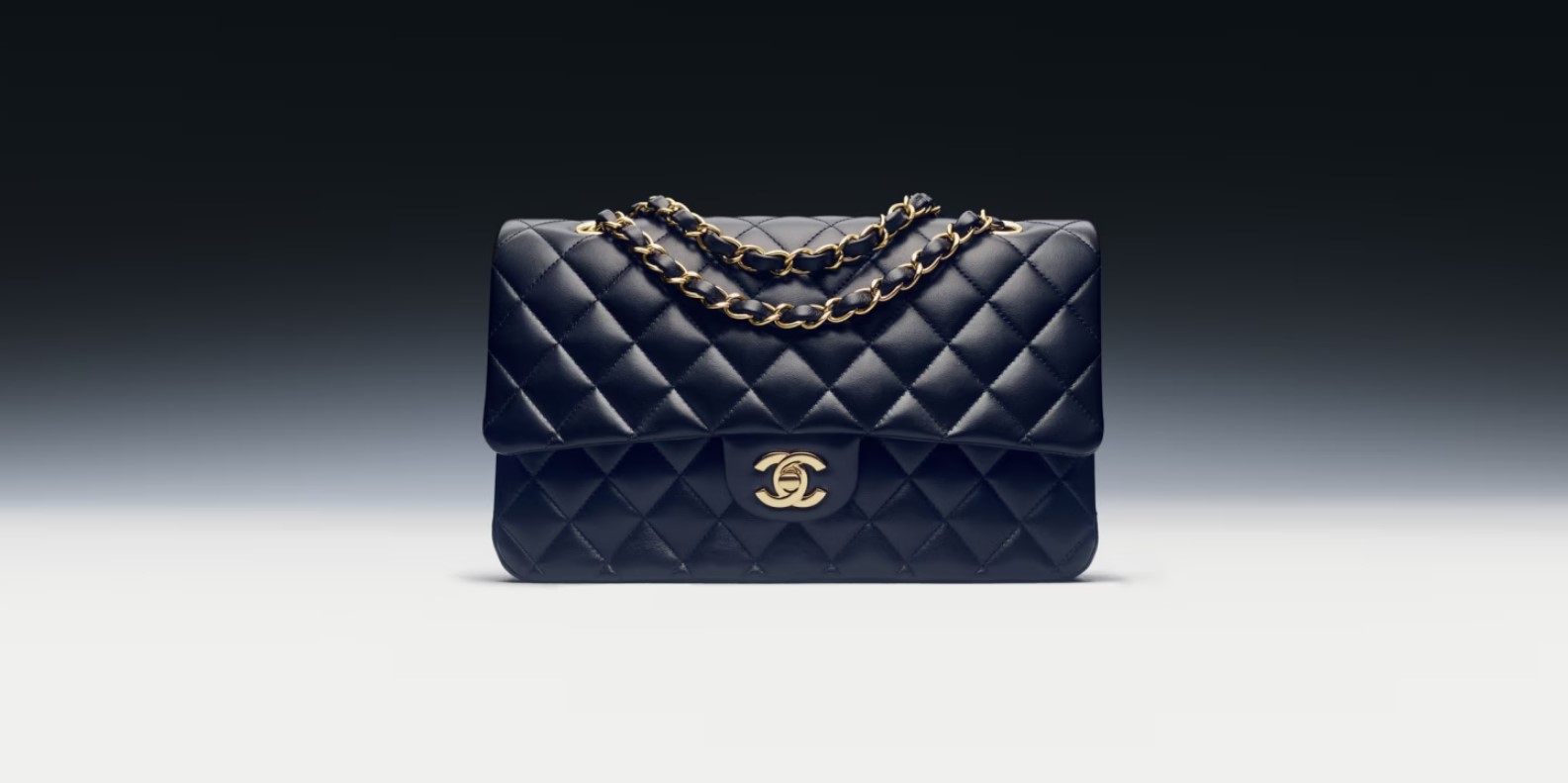
Few handbags have experienced a rise quite like the Chanel Classic Flap. Once simply one of fashion’s most coveted accessories, the iconic quilted bag has undergone extraordinary retail price increases over the past two decades—fueling an intriguing question among collectors and luxury lovers alike: Can a Chanel handbag actually be considered an investment?
With its signature diamond quilting, interlocking CC turn-lock and leather-woven chain strap, the Classic Flap has remained remarkably desirable across generations. Yet its appeal now extends beyond fashion. As Chanel has repeatedly raised retail prices, collectors have increasingly paid attention to the bag’s price history, resale value and enduring desirability.
The story also begins with an important distinction. In 1955, Gabrielle “Coco” Chanel introduced the 2.55, a revolutionary shoulder bag that helped free women from carrying handbags by hand. Nearly three decades later, Karl Lagerfeld reinterpreted Chanel’s original design, creating the Classic Flap in 1983 with the now-famous interlocking CC closure and leather-woven chain.
Today, the Classic Flap occupies an unusual place in luxury: part fashion icon, part collectible and, for some buyers, a potential store of value. But rising retail prices don’t automatically translate into investment returns—and not every Chanel bag performs equally on the resale market.
So, is the Chanel Classic Flap really a good investment—or simply an exceptionally beautiful handbag that has become extraordinarily expensive? Let’s look at its history, craftsmanship, extraordinary rise in price and what actually happens when a Chanel bag reaches the resale market.
From Coco Chanel’s 2.55 to the Classic Flap
To understand the Classic Flap, you have to go back to February 1955.
Gabrielle Chanel introduced the 2.55 at a time when elegant women’s handbags were traditionally carried by hand. Chanel’s addition of a chain shoulder strap was both practical and quietly rebellious, giving women something increasingly important: freedom of movement.
The original 2.55 established many of the codes we still associate with Chanel handbags today, including its quilted construction, chain strap and distinctive rectangular Mademoiselle turn-lock. Chanel itself describes the 2.55 as its first handbag and dates its creation to 1955.
Then came Karl Lagerfeld.
After becoming Chanel’s creative director in 1983, Lagerfeld reinterpreted the 2.55 for a new era. His Classic Flap introduced two elements that would become instantly recognizable around the world: the interlocking Double C turn-lock and a chain strap woven with leather.
The design was eventually renamed the Classic 11.12, a reference to the style code of the Medium Classic Flap, A01112.
That distinction matters. The 2.55 and Classic Flap are closely related Chanel icons—but they are not exactly the same bag.
What Makes the Chanel Classic Flap So Iconic?
Part of the Classic Flap’s strength is that it doesn’t depend heavily on fashion trends.
The quilted silhouette is immediately recognizable. So are the CC closure and leather-threaded chain. A black Classic Flap can be carried with denim in the afternoon and a cocktail dress that evening without looking out of place in either setting.
Then there is the craftsmanship.
According to Chanel, the Classic 11.12 is constructed like a garment, from the inside out, and requires more than 180 individual steps to complete.
That combination—heritage, craftsmanship and visual recognition—is difficult to manufacture overnight. Chanel has spent decades creating an object that communicates its identity even when the logo isn’t the first thing you notice.
And therein lies much of its value.
How Much Has the Chanel Classic Flap Increased in Price?
This is where the story becomes particularly interesting.
A Chanel Classic Flap bought decades ago cost a fraction of what a comparable bag costs today. Vintage examples from Karl Lagerfeld’s early Chanel years are particularly fascinating: Sotheby’s notes that Classic Flaps sold for around $1,000 in the 1980s, while excellent vintage examples can now command several times their original purchase price on the secondary market.
Retail pricing has accelerated especially dramatically in more recent years.
By 2026, Classic Flap pricing had reached five figures for many core versions and sizes in major markets. Sotheby’s reported approximately $11,700–$12,600 for Classic Double Flap styles in 2026, depending on model and size.
Prices also vary substantially by country, taxes, material and seasonal interpretation. For perspective, Chanel currently lists a classic black lambskin 11.12 on its Indian site at ₹1,109,500, while a Spring-Summer 2026 embellished version is listed at ₹1,331,200.
That’s an extraordinary evolution for a handbag.
But here’s where buyers need to make an important distinction.
Retail price appreciation is not the same thing as investment return.
Does a Chanel Classic Flap Actually Hold Its Value?
Generally, the Classic Flap has one of the strongest resale profiles in the luxury handbag market—but that doesn’t mean you’ll necessarily buy one at Chanel today and sell it tomorrow for a profit.
The secondary market is far more nuanced.
Resale values depend on size, leather, color, hardware, age, condition, rarity, provenance and current collector demand. Even two seemingly similar black Chanel bags can command very different prices.
Recent resale data illustrates the point. SACLÀB’s 2026 Chanel report found that its average resale values for the Timeless Classic Flap and 2.55 combined rose from approximately €3,170 in 2020 to €4,975 in 2024, before falling back to about €4,140 in 2025. Its data also showed the Timeless Classic outperforming the 2.55 in average resale value.
That’s a valuable reality check.
Luxury handbags can appreciate. They can also decline.
A Chanel handbag is therefore better viewed as a collectible luxury asset with potential value retention than as a substitute for a diversified investment portfolio.
Which Chanel Classic Flap Holds Its Value Best?
If value retention matters, some combinations tend to have broader collector appeal than others.
Black Is the Ultimate Classic
Fashion may embrace color, but black remains quintessential Chanel.
A black Classic Flap is instantly recognizable, seasonless and relatively easy to style. Sotheby’s identifies the vintage Medium Double Flap in black lambskin with gold hardware as particularly sought after among vintage Chanel collectors.
Neutral shades can also have broad appeal, while unusual colors may become highly desirable when the right collector is searching for a specific season.
Caviar vs. Lambskin
This is one of the great Chanel debates.
Lambskin is beautifully smooth, soft and luxurious, but it can be more susceptible to scratching and visible wear.
Caviar leather has a pebbled texture and is prized for its durability. Sotheby’s specifically notes its scratch-resistant quality, which makes it appealing for a bag intended to be worn regularly.
For a collector focused heavily on maintaining condition, caviar can therefore be particularly attractive.
But don’t dismiss lambskin. The classic black lambskin-and-gold combination has enormous heritage appeal, especially in the vintage market.
Condition Is Everything
A beautiful bag that’s actually been used is not a failure. After all, Chanel created handbags to be worn.
But condition matters enormously at resale.
Scratched hardware, corner wear, staining, misshapen structure, odors, damaged interiors and poor restoration can all affect desirability.
If you’re buying partly with future value in mind, treat the bag well—but don’t become so frightened of depreciation that you never take it out of the box.
Luxury should still be enjoyed.
Vintage Chanel vs. Buying New
This may be one of the most interesting questions for today’s buyer.
Buying new gives you the full Chanel boutique experience, current craftsmanship, pristine condition and the pleasure of being the bag’s first owner.
Vintage offers something different.
Earlier Classic Flaps represent particular periods of Chanel history, especially the Lagerfeld years. Certain vintage pieces also feature characteristics collectors actively seek, and, of course, the entry price may differ substantially from buying today’s equivalent at retail.
Sotheby’s notes that Chanel bags from Lagerfeld’s early years in the 1980s and 1990s remain particularly sought after by vintage collectors.
A great vintage Classic Flap therefore isn’t simply the less-expensive alternative to a new Chanel.
In some cases, the history is precisely the point.
Why Chanel Price Increases Matter
One reason the Classic Flap receives so much attention as a potential store of value is Chanel’s retail pricing trajectory.
When the price of a new bag rises, pre-owned sellers don’t operate in a vacuum. Buyers compare the cost of a vintage or nearly-new bag with the price of walking into a boutique and purchasing its current equivalent.
Historically, retail increases have sometimes been followed by higher secondary-market values. Rebag’s resale research has previously observed a relationship between Chanel retail price increases and subsequent movements in resale values.
But the relationship isn’t automatic.
At some point, retail prices can rise faster than buyers are willing to pay on the secondary market. That’s why the gap between Chanel’s boutique price and achievable resale price is more useful than simply looking at how much retail prices have risen.
Is Chanel Better Than Hermès as an Investment?
The comparison is inevitable.
Hermès Birkin and Kelly bags occupy a somewhat different position in the luxury handbag market because access to highly coveted examples can be extremely restricted. If you’ve ever wondered how that system works, read Global Glam’s guide to the Hermès quota bag and the much-discussed pre-spend game.
Chanel offers a different proposition.
The Classic Flap has extraordinary brand recognition and collector demand without exactly replicating the Birkin-and-Kelly purchasing ecosystem. For some buyers, that makes Chanel more approachable; for others, the scarcity surrounding certain Hermès bags is part of their investment appeal.
The better question may not be Chanel or Hermès?
It may be: Which bag would you still be thrilled to own if its resale price never increased?
That’s the luxury purchase we prefer.
Where You Buy Matters
Authentication is critical when spending thousands of dollars on a Chanel handbag.
Buying directly from Chanel provides certainty about provenance. When purchasing pre-owned, work with established luxury resellers, auction houses or specialists that provide robust authentication and clear condition reporting.
And if part of the pleasure is buying your Chanel while traveling, location can make the experience unforgettable.
Paris, London, Milan, New York and Tokyo offer some of the world’s great luxury-shopping experiences. Global Glam’s guide to the most luxurious shopping streets in the world takes you from Avenue Montaigne and Bond Street to Via Montenapoleone, Ginza and Madison Avenue.
You can also explore our guide to the most luxurious department stores in the world, including destinations such as Harrods, Selfridges and Bergdorf Goodman.
Because sometimes the story of where you bought the bag becomes part of why you love it.
Should You Buy a Chanel Classic Flap in 2026?
If your only goal is financial return, we’d hesitate to call any handbag a conventional investment.
There are selling commissions, authentication costs, market fluctuations, condition risks and no guarantee that a buyer will pay what you expect when you’re ready to sell.
But that’s only half the story.
Unlike a stock certificate sitting in an account, a Chanel Classic Flap can be worn for years. It can become associated with trips, celebrations and important moments. It can be passed from mother to daughter. And if chosen carefully and maintained well, it may retain a meaningful portion of its value—or, in the case of certain desirable vintage and collectible pieces, appreciate over time.
That combination of utility, beauty, history and potential value retention is what makes luxury handbags such an unusual category of collectible.
Global Glam’s Take: Is the Chanel Classic Flap a Good Investment?
Yes—with an asterisk.
The Chanel Classic Flap has demonstrated remarkable longevity, extraordinary retail price growth and strong collector recognition. Certain vintage pieces have risen substantially from their original prices, and desirable Classic Flaps continue to command meaningful prices on the secondary market.
But we wouldn’t buy one expecting a guaranteed financial return.
Buy the Classic Flap because you love Chanel. Buy it because you appreciate the history that began with Gabrielle Chanel’s 2.55 and evolved through Karl Lagerfeld’s 1983 reinterpretation. Buy it because you’ll actually carry it.
Then choose wisely: a classic size, timeless color, desirable leather, excellent condition and impeccable provenance give you the strongest foundation if future resale value matters.
And perhaps that’s the real secret to investing in luxury.
The best investment may be the piece you can enjoy for decades—and still have something valuable to show for it at the end.
Images courtesy of Chanel