
By Christine Philip
Luxury has always been about more than possessions. At its most sophisticated, it is about the ability to recognize, preserve, and participate in things that carry meaning beyond their material value. Few objects demonstrate this more powerfully than great works of art. Long before contemporary collectors competed for masterpieces at international auctions, paintings offered wealthy patrons a way to communicate taste, influence, education, ambition, and social position.
Two portraits separated by nearly five centuries—Jan van Eyck’s The Arnolfini Portrait and Gustav Klimt’s Portrait of Adele Bloch-Bauer I—demonstrate just how enduring that relationship between art and status can be. Created in 1434 and 1907 respectively, the paintings belong to radically different artistic worlds. Yet both transform wealth into visual language, surrounding their subjects with details that speak to privilege, sophistication, and cultural ambition.
Today, the way luxury is displayed has changed. The grand interiors and elaborate costumes of Renaissance portraiture have given way to private collections, museum patronage, contemporary art fairs, and architect-designed homes. But the fundamental impulse remains remarkably familiar: to possess something rare, understand its significance, and place oneself within its story.
A Portrait of Wealth
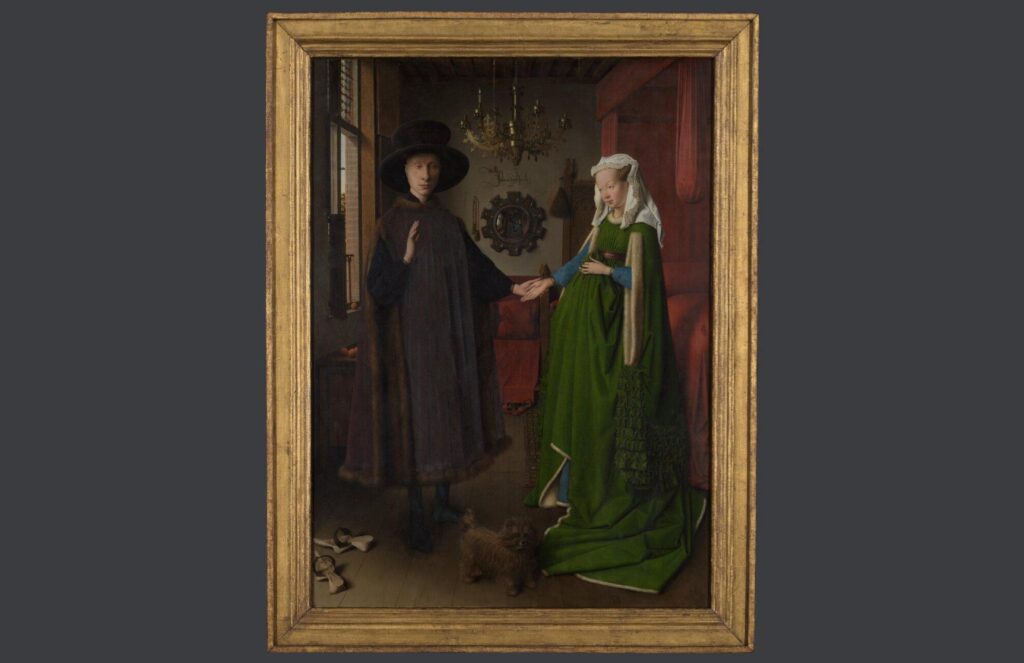
Image courtesy of The National Gallery
At first glance, The Arnolfini Portrait appears to be a remarkably intimate domestic scene. A richly dressed couple stand inside a room in Bruges, surrounded by objects that seem almost ordinary. Yet the painting is carefully constructed, and virtually every detail contributes to the impression of prosperity.
The National Gallery identifies the couple as probably Giovanni di Nicolao Arnolfini, an Italian merchant working in Bruges, and his wife. The museum notes that the objects within the room were deliberately selected to communicate wealth and social status.
The details reward close attention. The woman wears a luxurious fur-trimmed garment; the man is dressed in an imposing hat and richly colored clothing. A brass chandelier hangs above them, a bed occupies part of the room, and oranges sit near the window. Even the convex mirror on the rear wall becomes an extraordinary display of craftsmanship.
These objects were not simply decorative. They were visual evidence of a prosperous life.
The painting itself was also an extraordinary demonstration of luxury craftsmanship. Van Eyck’s oil technique allowed him to create minute details and convincing reflections, making materials appear almost tangible. The National Gallery describes the work as one of the earliest Western European paintings to demonstrate the extraordinary possibilities of oil paint for realistic depictions of people and objects.
In other words, the painting does two things simultaneously. It depicts wealth, and it is itself a luxury object.
That distinction remains important today.
The modern luxury consumer may no longer commission a portrait surrounded by oranges, chandeliers, and fur to announce social standing. Instead, status can be communicated through the acquisition of a rare contemporary artwork, membership in a private art institution, a collection displayed in a carefully designed residence, or philanthropic support for a museum.
The language has changed. The message has not.
From Possession to Cultural Capital
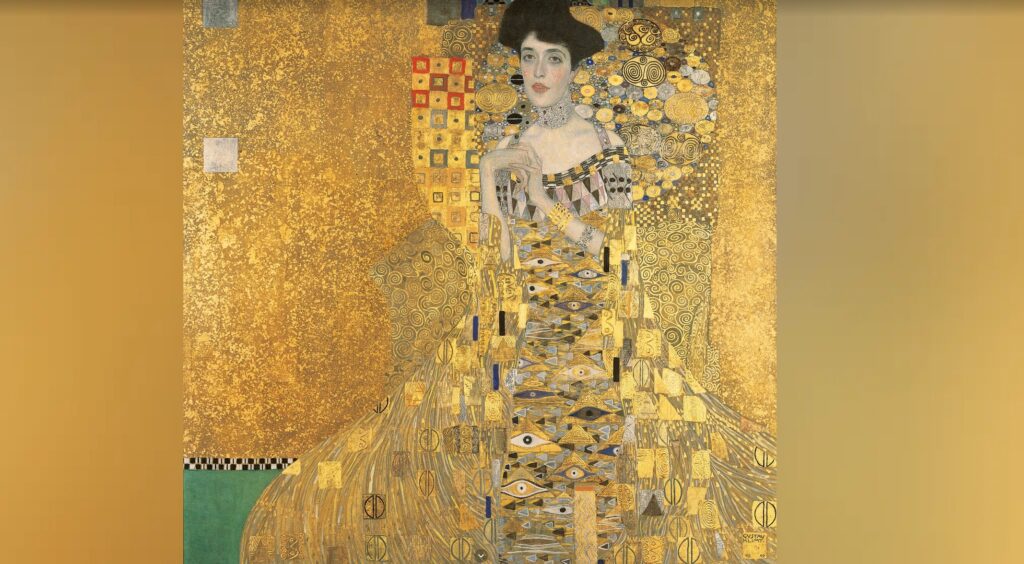
Image courtesy of Google Arts & Culture
By the time Klimt painted Portrait of Adele Bloch-Bauer I in 1907, luxury had acquired a new visual vocabulary.
Adele Bloch-Bauer belonged to one of Vienna’s prominent affluent families, and she and her husband, Ferdinand Bloch-Bauer, assembled an important art collection that included works by Klimt as well as sculpture, porcelain, and paintings from earlier periods. The portrait originally hung in Adele’s private apartment in their Vienna home.
Klimt’s portrait is almost overwhelming in its opulence. Gold and silver cover much of the canvas, while intricate patterns and jewel-like forms transform Adele’s clothing and surroundings into something approaching a piece of haute jewelry. The Neue Galerie describes the work as the culmination of Klimt’s celebrated “golden style,” influenced in part by the Byzantine mosaics Klimt encountered in Ravenna.
Yet the painting’s significance extends far beyond its surface beauty.
Unlike the more literal material signals of The Arnolfini Portrait, Klimt’s vision turns wealth into aesthetic sophistication. Gold is no longer simply a precious material; it becomes an artistic language. Ornament becomes abstraction. Portraiture becomes spectacle.
The result is a fascinating evolution in the meaning of luxury. In van Eyck’s world, possessions communicate prosperity. In Klimt’s, artistic taste itself becomes a form of distinction.
That idea remains central to luxury collecting today.
When Art Becomes Legacy
Perhaps the most compelling aspect of Portrait of Adele Bloch-Bauer I is not its gold but its history.
In 1938, the painting was among the Klimt works seized from the Bloch-Bauer family by the Nazis. For decades, it remained in Vienna under the name “Woman in Gold,” obscuring the identity of its original sitter. Maria Altmann, Adele’s niece and an heir to the family collection, ultimately pursued restitution. A 2005 decision led to the paintings being returned to the heirs, and in 2006 Ronald S. Lauder acquired Portrait of Adele Bloch-Bauer I for Neue Galerie New York, where it has remained on permanent view.
The story illustrates something fundamental about the value of art.
A masterpiece cannot be reduced to its market price.
Its value can encompass artistic innovation, provenance, historical trauma, family memory, cultural identity, and institutional significance. Ownership becomes intertwined with responsibility. A collector does not simply possess the object; they become one chapter in its continuing history.
This is one reason great art occupies such a distinctive position within the luxury world. A watch can be inherited. A piece of jewelry can become a family heirloom. A historic automobile can pass from one generation to another. But a major painting can carry an entire cultural narrative with it.
Its significance can increase precisely because of everything that has happened around it.
The Modern Collector
The contemporary art collector therefore occupies a role that is surprisingly close to that of the patrons of earlier centuries.
The difference is that status today is often communicated more subtly.
Luxury has increasingly moved away from conspicuous consumption toward cultural capital. The most sophisticated collectors may be less interested in displaying a recognizable logo than in demonstrating knowledge: understanding an artist’s importance before the wider market catches on, discovering an emerging painter, supporting a museum, or building a collection around a particular historical movement.
This is why art fairs, private galleries, museum exhibitions, and cultural foundations have become such important components of the luxury ecosystem.
A painting hanging in a private residence can become a conversation piece, but it can also represent something more personal: an intellectual interest, a family legacy, or a long-term commitment to culture.
The modern collector may even see ownership as temporary. Works can move between private collections, exhibitions, foundations, and museums. Their value lies partly in being entrusted with something that will outlive the individual who owns it.
That idea brings us back to van Eyck.
The Arnolfini Portrait has passed through the hands of aristocrats, royal collections, and private owners before being acquired by the National Gallery in 1842. The museum records Don Diego de Guevara, a Spanish nobleman and its first recorded owner, among the painting’s early custodians.
What was once a private object is now a public treasure.
The same transformation can be seen in Klimt’s portrait. What began as a family possession eventually became the centerpiece of a New York museum collection, where it is seen by visitors from around the world.
The Enduring Luxury of Looking
Perhaps the greatest luxury today is not simply owning something expensive. It is having the time, knowledge, and curiosity to look closely.
That is what makes these two paintings so enduring. The Arnolfini Portrait rewards viewers who examine its objects, reflections, textures, and inscriptions. Portrait of Adele Bloch-Bauer I invites attention to its layers of gold, ornament, symbolism, and history.
Both paintings remind us that luxury is ultimately a form of attention.
The wealthy merchants of fifteenth-century Bruges and Vienna’s early twentieth-century elite understood that art could preserve identity and communicate aspiration. Today’s collectors understand the same principle, even if the objects and environments have changed.
The contemporary luxury landscape may be filled with private jets, superyachts, haute couture, and rare watches, but art occupies a different category. It does not simply demonstrate what someone can afford. At its highest level, it demonstrates what someone chooses to value.
And perhaps that is why great art continues to define status.
Not because it is expensive, but because it carries something money alone cannot manufacture: history, rarity, cultural meaning, and the possibility of becoming part of a story that began long before its current owner—and will continue long after them.